

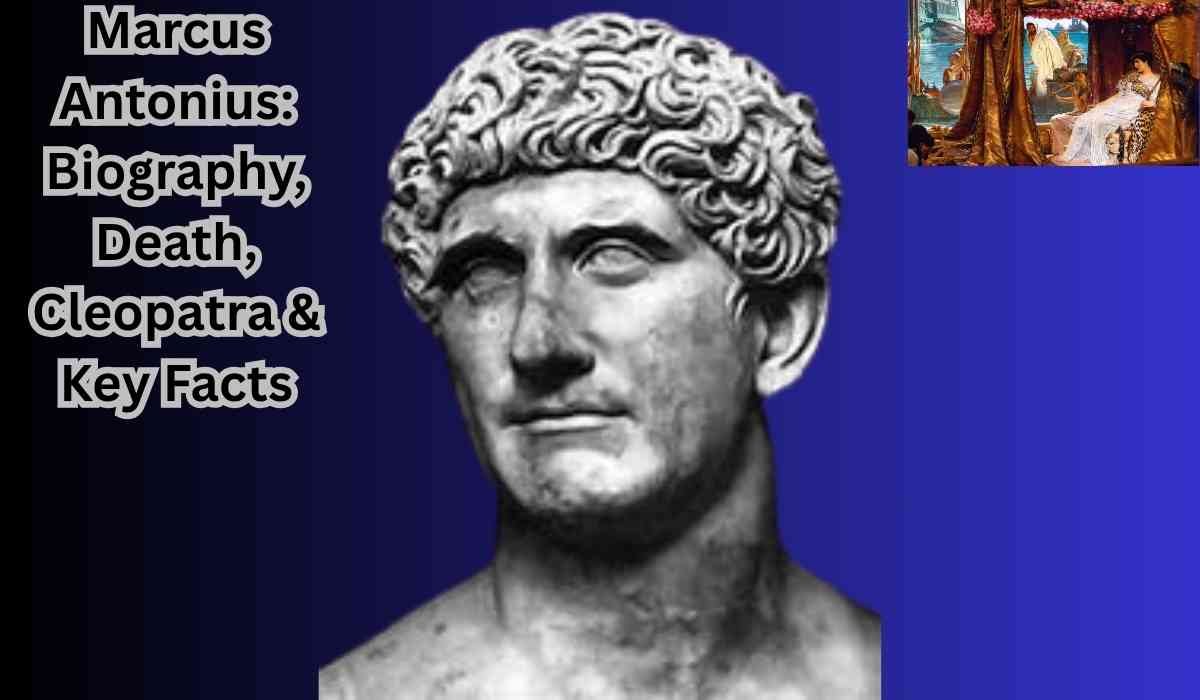
Marcus Antonius, better known as Mark Antony, was one of Rome’s most powerful and controversial figures. A brilliant general and bold politician, he shaped the late Roman Republic in ways few others could. His story is full of ambition, loyalty, betrayal, and passion.
His life remains fascinating even today. From his alliance with Julius Caesar to his legendary relationship with Cleopatra VII, Mark Antony’s biography reads like something between a history lesson and a drama. He lived boldly and fell just as hard.
Marcus Antonius Biography
Marcus Antonius biography begins in Rome around 83 BC, where he was born into a noble but troubled family. He grew up in a city defined by political tension, military power, and shifting alliances. His early years shaped his fierce ambition and his lifelong connection to Roman military life and public service.
Despite family hardships, Antony rose through Rome’s ranks with remarkable speed. His charisma, physical presence, and loyalty to powerful allies helped him climb fast. Mark Antony history shows a man who was never content staying in the background, always pushing toward the center of Roman power.
Marcus Antonius Full Name and Identity
His full name in Latin was Marcus Antonius, later called Mark Antony in English.
- Full Latin name: Marcus Antonius
- Also known as: Mark Antony, Marc Antoine
- Born around: 83 BC in Rome
- Social class: Roman noble families, Antony branch
- Official roles: Tribune, Consul, General
Read More: BTS Arirang Album 2026: Release Date, Tracklist, Tour and Full Review
Early Life and Family Background
Marcus Antonius early life was shaped by instability, debt, and strong maternal influence.
- Mark Antony birth date and place: around 83 BC, Rome
- Mother: Julia Antonia, a respected Roman woman
- Stepfather: Publius Cornelius Lentulus Sura
- Antony education and youth: trained in rhetoric and military arts
- Spent time in Greece studying oratory before entering politics
- Mark Antony family background carried both prestige and financial struggle
Father of Marcus Antonius – Marcus Antonius Creticus
Marcus Antonius Creticus was Antony’s biological father and a Roman military commander, though not a particularly successful one.
- Father’s name: Marcus Antonius Creticus (meaning “the Cretan”)
- He led a failed military campaign in Crete around 74 BC
- Died young, leaving the family in significant debt
- His failure in Crete earned him the ironic nickname “Creticus”
- Marcus Antonius parents left him with ambition but little financial security
- Grandfather: the orator Marcus Antonius, a respected Roman speaker
Rise of Mark Antony in Roman Politics
Mark Antony’s political rise was fast and full of bold moves. His military skill and personal loyalty to powerful figures helped him gain influence quickly. As a Mark Antony Roman general, he proved himself on battlefields across the Roman world, building a reputation that made him impossible to ignore in Roman political circles.
His Antony rise to power was never accidental. He understood people, read rooms well, and knew when to act. Antony political career moved from military service to high political office in just a few years, placing him among Rome’s most influential decision-makers during one of its most unstable periods.
| Political Role | Year | Significance |
|---|---|---|
| Tribune of the Plebs | 49 BC | Supported Caesar’s cause |
| Consul | 44 BC | Highest Roman civil office |
| Master of the Horse | 47 BC | Caesar’s deputy in Rome |
| Member of Second Triumvirate | 43 BC | Shared rule of Rome |
Alliance with Julius Caesar
Mark Antony Julius Caesar alliance was the defining partnership of Antony’s early career.
- Served under Caesar during the Antony Gallic Wars role
- Became Caesar’s most trusted military lieutenant
- Helped Caesar cross the Rubicon in 49 BC
- Delivered the famous funeral speech after Caesar’s assassination
- This speech turned Roman public opinion against the conspirators
- Cemented his position as Rome’s most powerful man after Caesar
Role in Roman Civil Wars
Antony civil war Pompey involvement proved his military leadership under real pressure.
- Fought alongside Caesar against Pompey’s forces
- Commanded the left wing at the Battle of Pharsalus in 48 BC
- Antony military leadership was recognized across the Roman army
- After Caesar’s death, fought against Brutus and Cassius
- Won decisively at the Battle of Philippi Antony in 42 BC
- These victories made him the dominant force in the Roman East
Formation of the Second Triumvirate
The Second Triumvirate Mark Antony formed with Octavian and Lepidus changed Rome completely.
- Formed officially in 43 BC through the Lex Titia
- Members: Antony Octavian Lepidus alliance as joint rulers
- Roman power division Antony: he controlled the eastern provinces
- Lepidus received Africa; Octavian took the western regions
- This arrangement gave Antony enormous wealth and military resources
- Triumvirate Roman history marks the beginning of Rome’s transition to empire
Marcus Antonius and Cleopatra VII
The story of Mark Antony and Cleopatra is one of history’s most famous romances, but it was also deeply political. When Antony met Cleopatra VII in 41 BC at Tarsus, the connection was immediate. She arrived on a golden barge, dressed as Aphrodite, and the meeting changed both their lives and the fate of empires.
Their Antony Cleopatra relationship mixed love with strategy. Cleopatra needed Rome’s military protection; Antony needed Egypt’s wealth. Together they were formidable. But in Rome, their relationship was seen as scandalous and dangerous, especially as Antony drifted away from Roman values and deeper into Egyptian court life.
| Aspect | Details |
|---|---|
| First Meeting | 41 BC at Tarsus, modern Turkey |
| Political Goal | Alliance between Rome and Egypt |
| Personal Bond | Romantic relationship lasting until death |
| Roman Reaction | Seen as betrayal of Roman values |
Love Story and Political Alliance
Antony love story Cleopatra was both genuine and politically calculated from the start.
- Met Cleopatra in 41 BC after summoning her to Tarsus
- She arrived dramatically, making an unforgettable first impression
- They wintered together in Alexandria in 41 to 40 BC
- Antony had previously married Antony Octavia marriage to maintain Roman ties
- He eventually abandoned Octavia to return permanently to Cleopatra
- Cleopatra VII biography describes her as brilliant, multilingual, and politically sharp
Children and Royal Legacy
Mark Antony children with Cleopatra were given royal titles and territories, shocking Rome.
- Alexander Helios: given Armenia and Media
- Cleopatra Selene: given Cyrenaica and Libya
- Ptolemy Philadelphus: given Syria and Cilicia
- These children were recognized as rulers at very young ages
- Antony also had children from earlier Roman marriages
- His son Antyllus was later executed by Octavian after Antony’s death
Donations of Alexandria
The Donations of Alexandria in 34 BC was a public ceremony that outraged Rome.
- Antony declared Cleopatra “Queen of Kings” during this ceremony
- Donations of Alexandria explained: territories given to Cleopatra’s children as kingdoms
- Caesar’s son Caesarion was declared legitimate heir to Julius Caesar
- This directly challenged Octavian’s claim as Caesar’s political heir
- The Roman Senate used this event to turn public opinion against Antony
- It became the propaganda moment that justified war against him
War, Conflict, and Downfall
The Antony war with Octavian had been building for years through political tension and propaganda. Octavian was smart enough to let public anger do much of his work. By portraying Antony as a man seduced by an Egyptian queen and turned against Rome, he made the coming war feel like a moral necessity rather than a power grab.
The conflict escalated quickly once diplomacy failed. Rome declared war not on Antony directly but on Cleopatra, a clever legal move. The two sides finally clashed at sea off the Greek coast in 31 BC. Antony Cleopatra’s combined forces were strong on paper, but events on the day would prove catastrophic.
Rivalry with Augustus
Mark Antony vs Octavian rivalry grew from political tension into open personal hostility.
- The Second Triumvirate began breaking down after 40 BC
- Antony rivalry Octavian intensified with the Donations of Alexandria
- Octavian used propaganda to paint Antony as a traitor to Rome
- He read Antony’s will publicly to inflame Roman citizens
- Roman political conflicts reached a breaking point by 32 BC
- The Senate stripped Antony of all official powers in 32 BC
The Battle of Actium
Battle of Actium Mark Antony on September 2, 31 BC decided the fate of the Roman world.
- Fought off the coast of northwestern Greece
- Actium battle summary: Octavian’s fleet, led by Agrippa role Actium, outmaneuvered Antony
- Cleopatra’s fleet withdrew early during the battle
- Antony followed her, abandoning his troops and naval forces
- Roman naval battle Actium ended in complete defeat for Antony’s side
- This battle effectively ended the fall of Roman Republic Antony era
Fall of Roman Republic
The fall of Roman Republic Antony era marked the end of centuries of republican governance.
- After Actium, Antony’s remaining forces surrendered to Octavian
- Antony escape to Egypt after the battle sealed his fate completely
- Egypt was no longer a safe haven as Octavian advanced rapidly
- The Senate’s authority was now practically irrelevant
- Octavian became Augustus in 27 BC, the first Roman Emperor
- Antony military failure at Actium is seen as the republic’s final collapse
Marcus Antonius Death
Mark Antony death in 30 BC closed one of Rome’s most dramatic chapters. After his crushing defeat at Actium and Octavian’s swift march into Egypt, Antony had nowhere left to go. He had lost his army, his political allies, and his hope for any future in power. Alexandria was the last place he could call home.
In his final days, Antony was broken but not without dignity. He died as a Roman soldier, on his own terms, rather than face the humiliation of being paraded through Rome as a captured enemy. Mark Antony suicide is remembered as a tragic but deeply human ending to a remarkable and turbulent life.
How Did Marcus Antonius Die
How did Mark Antony die is one of history’s most asked questions about the ancient world.
- Received false news that Cleopatra had already died
- In grief, he fell on his own sword, a Roman military tradition
- Mark Antony suicide was not immediately fatal; he lingered for hours
- He was carried to Cleopatra’s mausoleum where she was hiding
- Died in her arms, reportedly in August 30 BC
- Antony final moments were recorded by Plutarch in vivid detail
Death in Alexandria
Antony death Alexandria happened inside Cleopatra’s fortified mausoleum near the royal palace.
- He died on August 1, 30 BC, according to most historical sources
- Cleopatra had barricaded herself in her tomb fearing capture
- Antony’s dying wish was to be buried beside Cleopatra
- Octavian entered Alexandria just days after Antony’s death
- Antony burial location remains unknown as no confirmed tomb has been found
- His death marked the beginning of Octavian’s complete control of Egypt
Cleopatra’s Death and Aftermath
Cleopatra death story followed Antony’s by just days, ending an era completely.
- Cleopatra died on August 12, 30 BC, roughly eleven days after Antony
- Cleopatra suicide snake myth: she reportedly died from an asp’s bite
- Historians debate whether it was a snake, poison, or a needle
- Octavian had wanted to display her in his Roman triumph parade
- Caesarion execution: her son by Julius Caesar was killed by Octavian’s orders
- Egypt became a Roman province immediately after both deaths
Books and Cultural Impact
Mark Antony in literature has inspired writers, playwrights, and historians for over two thousand years. From Shakespeare’s stage to modern historical fiction, his life keeps pulling people in. The combination of military greatness, political drama, and a love story powerful enough to change empires makes him irresistible as a subject for storytelling and serious scholarship alike.
The Antony portrayal in media has ranged from noble to foolish to everything in between. Shakespeare gave him one of literature’s most famous speeches. Historians gave him complex analysis. Filmmakers gave him drama and spectacle. Whatever the angle, books about Mark Antony consistently find eager readers who want to understand this complicated man on his own terms.
Antony and Cleopatra Overview
Antony and Cleopatra Shakespeare remains one of the most performed plays in the English language.
- Written around 1606 to 1607 by William Shakespeare
- Based on Plutarch’s “Life of Antony” from his Parallel Lives
- Shakespeare tragedy analysis Antony: explores love, loyalty, and political ruin
- Antony’s famous speech in Julius Caesar comes from an earlier Shakespeare play
- Shakespeare Julius Caesar Antony speech (“Friends, Romans, countrymen”) is still widely quoted
- The play shows Antony as both heroic and deeply flawed
Ancient Sources and Historical Records
Historical sources Antony come mostly from writers who lived after his death.
- Plutarch Life of Antony: the most detailed ancient biography available
- Plutarch wrote with moral judgment but genuine historical detail
- Appian’s “Civil Wars” covers the political context thoroughly
- Cassius Dio provides additional Roman perspective on Antony’s life
- Roman literature Antony: sources often reflect Octavian’s propaganda machine
- Modern historians must read these sources critically for balanced understanding
Modern Books on Marcus Antonius
Roman history books Antony today combine ancient sources with modern archaeology and analysis.
| Book Title | Author | Focus |
|---|---|---|
| Antony and Cleopatra | Adrian Goldsworthy | Military and political biography |
| Mark Antony: A Biography | Eleanor Goltz Huzar | Academic historical study |
| Antony | Pat Southern | Accessible narrative biography |
| The Triumvirate | Various scholars | The three-man rule of Rome |
Latest Updates and Discoveries
Mark Antony updates 2026 continue to emerge as archaeologists dig deeper into Egypt’s ancient sites. The search for Cleopatra tomb discovery has brought renewed attention to Antony’s story as well, since both are believed to have been buried together. Every new find in Alexandria or the surrounding region potentially adds to our understanding of this remarkable period.
New research Mark Antony also comes from digital tools and reanalyzed ancient texts. Scholars are using satellite imaging, ground-penetrating radar, and updated translations to challenge old assumptions. The line between legend and fact is slowly getting clearer, and each update reminds us how much we still don’t fully understand about the ancient world.
Cleopatra Tomb Research
Cleopatra tomb discovery efforts are ongoing and have produced genuinely exciting results in recent years.
- Taposiris Magna excavation: a temple site west of Alexandria under active dig
- Kathleen Martinez excavation: led by Dominican archaeologist who believes the tomb is there
- Tunnels discovered beneath the site in 2022 suggest major underground structures
- Antony Cleopatra tomb search intensified after water-damaged tunnels were found intact
- No confirmed tomb found yet, but evidence points strongly to this region
- Cleopatra burial mystery keeps archaeologists and historians returning to the site
Modern Historical Views on Antony
Antony modern historical views have shifted significantly away from the propaganda Octavian spread.
- Older views often portrayed him as weak and controlled by Cleopatra
- Roman history new findings show he was a capable and strategic military leader
- Scholars now recognize Octavian’s narrative shaped ancient sources heavily
- His eastern policies are seen as practical, not as a betrayal of Rome
- Mark Antony archaeology provides physical evidence that adds nuance to written accounts
- Modern consensus: a complex man caught between two worlds, not simply a romantic fool
Documentaries and Media Coverage
Roman Empire documentaries regularly feature Antony as a central character in Rome’s collapse.
- Netflix series “Roman Empire” covered Antony’s story in accessible, dramatic style
- BBC documentaries have explored the Antony Cleopatra relationship in historical depth
- Mark Antony archaeology findings are frequently covered in news and academic media
- Smithsonian Channel, History Channel, and National Geographic have all produced relevant content
- Antony portrayal in media has become more historically nuanced over the past decade
- Growing public interest has pushed more serious scholarship into mainstream platforms
Key Facts About Marcus Antonius
Understanding Marcus Antonius biography means looking beyond the love story and the drama. His actual record as a military commander, a politician, and a statesman was genuinely impressive. He held some of Rome’s highest offices, won major battles, and governed vast territories. The tragedy is that he ended up on the losing side of history’s most consequential power struggle.
Mark Antony biography shows a man of real talent undone by a combination of personal choices and an opponent in Octavian who was simply more calculating and patient. History written by winners tends to flatten the losers. Antony deserves a fuller look because his contributions to Roman history, including the transition toward empire, were real and lasting.
| Fact | Detail |
|---|---|
| Born | Around 83 BC, Rome |
| Died | August 1, 30 BC, Alexandria |
| Cause of Death | Self-inflicted sword wound |
| Major Ally | Julius Caesar |
| Greatest Love | Cleopatra VII of Egypt |
| Biggest Defeat | Battle of Actium, 31 BC |
| Children | At least five known children |
Major Achievements
Mark Antony Roman general accomplishments were substantial and changed the course of Roman history.
- Played a key role in Caesar’s military campaigns across Gaul and Greece
- Won the decisive Battle of Philippi Antony against Caesar’s assassins in 42 BC
- Governed Rome’s wealthy eastern provinces with considerable political skill
- Built one of the ancient world’s most powerful political and military alliances
- His funeral speech for Caesar is considered one of history’s greatest political moments
- Controlled more territory at his peak than almost any Roman before him
Political Legacy
Antony legacy Rome is complicated because Octavian spent years trying to erase it.
- His defeat made the Roman Empire possible under Augustus
- Role of Mark Antony in Roman Republic: he was its last great champion in the East
- His eastern alliance model influenced how Rome governed provinces afterward
- Children from his marriage to Octavia became ancestors of later Roman emperors
- Mark Antony history shows a man whose loss shaped the world as much as any victory
- Without Antony’s fall, Augustus might never have achieved unchallenged power
Role in the Rise of the Roman Empire
Antony role after Julius Caesar death was to hold Rome together during its most fragile moment.
- He prevented immediate chaos after Caesar’s assassination in 44 BC
- His rivalry with Octavian forced both men to become stronger leaders
- The Second Triumvirate Mark Antony system created administrative structures Rome built on later
- His defeat at Actium removed the last obstacle to one-man rule in Rome
- Mark Antony defeat paradoxically accelerated Rome’s transformation into a great empire
- Without the conflict between Antony and Octavian, Roman imperial history unfolds very differently
Conclusion
Marcus Antonius was far more than a man who fell in love with an Egyptian queen. He was a general who won battles, a politician who shaped empires, and a Roman who lived life on a massive scale. His story sits at the exact turning point between Rome’s republic and its imperial future, and his role in that shift was enormous.
History hasn’t always been fair to him, partly because Octavian wrote much of the narrative. But reading deeper, you find a man of real ability, real loyalty, and real humanity. Mark Antony’s biography is ultimately a reminder that even brilliant people can be broken by the right combination of circumstances, opponents, and their own choices.
