

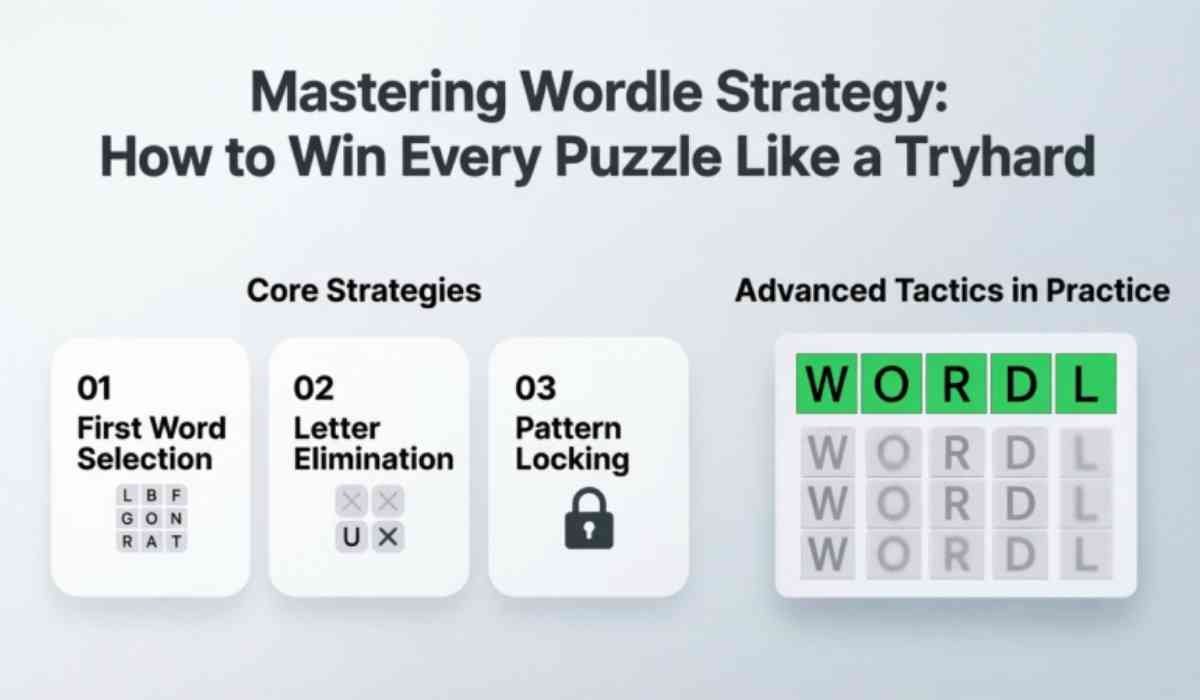
Mastering Wordle looks simple until you’re staring at a blank grid with no idea where to start. The truth is, casual players guess randomly while tryhards use a real Wordle strategy built on logic and letter patterns. The difference between a lucky win and a consistent one comes down to how you think.
If you’ve ever wanted to know how to win Wordle every single day without relying on luck, you’re in the right place. This guide breaks down everything from starting words to advanced tactics, so you can stop guessing and start solving like you actually know what you’re doing.
Best Wordle Strategy Guide
A good Wordle puzzle strategy isn’t about memorizing words. It’s about narrowing down possibilities fast. Every guess should give you new information, not just hope. Think of each guess like a question you’re asking the puzzle, and make sure every answer counts.
Most players waste guesses by repeating letters they already know are wrong. A smart approach uses strategic guessing in Wordle to cover as many new letters as possible early on. Plan your first two guesses before you even start typing.
| Strategy Level | Approach | Average Solve |
|---|---|---|
| Casual | Random guessing | 5-6 guesses |
| Intermediate | Vowel-first method | 4 guesses |
| Tryhard | Letter frequency + elimination | 3 guesses |
| Expert | Pre-planned word pairs | 2-3 guesses |
Key points to remember:
- Never repeat a gray letter in your next guess
- Treat every color clue as data, not decoration
- Plan your first two words as a unit, not separately
- Logical deduction in Wordle beats intuition every time
How to Win Wordle Every Time
Winning every puzzle means building a system, not relying on instinct. How to solve Wordle every time comes down to three things: a strong opener, smart elimination, and reading the color clues correctly. Once you lock in that system, streaks become normal.
The players who win consistently use word pattern recognition to spot where letters likely sit. They don’t just know what letters are in the word. They know where those letters probably aren’t, and that negative information is just as powerful.
Steps to win consistently:
- Start with a high-coverage word every single day
- Use green and yellow clues together, not separately
- Eliminate entire letter groups with one smart guess
- Keep a mental list of common five-letter endings
- Don’t get attached to a word you like; follow the data
Read More: Who Is Chester Koong? Biography, Website, and Online Presence Explained
Best Starting Words for Wordle
Your first guess is the most important move in the game. The best Wordle starting words hit the most common letters in the most common positions. Words like CRANE, SLATE, AUDIO, and RAISE consistently perform well because they cover high-frequency letters efficiently.
The goal isn’t to guess the answer on move one. It’s to gather as much information as possible. A vowel-rich starter word combined with common consonants gives you a strong foundation for every puzzle that follows.
| Starting Word | Vowels Covered | Top Consonants |
|---|---|---|
| CRANE | A, E | C, R, N |
| SLATE | A, E | S, L, T |
| RAISE | A, I, E | R, S |
| AUDIO | A, U, I, O | D |
| STARE | A, E | S, T, R |
Top picks and why:
- CRANE hits four of the top six most common Wordle letters
- SLATE covers S, which appears in a huge chunk of answers
- AUDIO is great for vowel mapping on puzzle types
- Avoid words with repeated letters on your opener
- The best first word in Wordle balances vowels and consonants
Wordle Letter Frequency Tips
Not all letters show up equally in five-letter words. Letter frequency analysis in Wordle shows that E, A, R, O, T, L, I, S, and N appear most often. Knowing this lets you build guesses that hit the highest-probability letters first.
This isn’t just theory. Players who use frequency data solve puzzles faster on average. When you know which letters dominate the answer pool, you stop wasting guesses on Q, Z, X, or J in early rounds.
| Letter | Frequency Rank | Common Position |
|---|---|---|
| E | #1 | 3rd, 5th |
| A | #2 | 2nd, 3rd |
| R | #3 | 3rd, 4th |
| O | #4 | 2nd, 3rd |
| T | #5 | 1st, 4th |
| L | #6 | 3rd, 4th |
How to use frequency data:
- Build your opener around E, A, R, O, and T
- Avoid low-frequency letters until guess three or four
- Use Wordle solving techniques that prioritize position data
- Track which letters you’ve confirmed and which remain open
- Let the frequency list guide you, but don’t ignore the clues you’ve earned
Smart Vowel Strategy in Wordle
Every five-letter Wordle answer contains at least one vowel, and most have two or three. A solid Wordle vowel strategy maps out A, E, I, O, and U early so you’re never stuck guessing blind in later rounds. Vowels are your anchors.
The vowel-rich starter words approach works because vowels narrow the search space fast. Once you know which vowels are in the word and roughly where they sit, consonants fall into place much more naturally. Don’t skip this step.
Smart vowel tips:
- Aim to confirm at least two vowels by guess two
- Use AUDIO or OURIE as second guesses to mop up remaining vowels
- A yellow vowel tells you position AND presence, use both pieces
- Wordle vowel strategy explained simply: confirm first, place second
- Words with double vowels (like QUEEN) are tricky, save those guesses for later
Common Consonant Patterns
Consonants carry the shape of a word. Common consonant combinations like ST, TR, CH, SH, and ND appear constantly in five-letter words. Recognizing these patterns early helps you guess smarter and place letters correctly without burning extra guesses.
The trick is understanding Wordle letter patterns that repeat across many answers. Endings like -TION, -NESS, -IGHT, and -ATCH narrow things down fast once you have a vowel or two confirmed. Pattern thinking beats random letter hunting every time.
Consonant patterns worth knowing:
| Pattern | Example Words | Position |
|---|---|---|
| ST | STARE, STONE, STING | Start |
| TR | TRAIN, TRUCK, TROVE | Start |
| SH | SHALE, SHINE | Start |
| ND | BLAND, FOUND, SPEND | End |
| NK | BLANK, DRINK, TRUNK | End |
- Watch for double consonants like LL, SS, and TT in mid-to-late rounds
- Wordle consonant frequency list puts R, S, T, L, N at the top
- SH and CH combos appear in roughly 8% of answers
- Learn common word endings: -LY, -ER, -ED, -AL are very common
- Ending consonant clusters help you make confident final guesses
Advanced Wordle Tryhard Tactics
This is where casual players and tryhards split. Advanced Wordle tactics involve pre-planned two-word openers, hard mode discipline, and sometimes deliberately sacrificing a guess to maximize information gain. It feels counterintuitive but it works.
The Wordle tryhard strategy also includes thinking about what the word is NOT. Every gray square is a gift. Players who track eliminated letters mentally (or on paper) solve puzzles in fewer guesses because they never backtrack into dead territory.
Tryhard moves that actually work:
- Use a fixed two-word combo every day, like CRANE + STOIL
- Play hard mode to train discipline, but switch off for streaks
- Sacrifice guess three for pure elimination when you’re stuck
- Pro Wordle player tips always include pre-game word pair planning
- Keep a personal log of tricky patterns you’ve hit before
- Competitive Wordle tips rely on consistency, not cleverness
How to Eliminate Wrong Letters
Wordle elimination strategy is half the game. Every gray letter you see should immediately disappear from your mental word list. The mistake most players make is subconsciously considering gray letters in future guesses, wasting moves on dead ends.
How to eliminate letters in Wordle efficiently means building your next guess around letters you haven’t tested yet. Think of it like a process of subtraction. The fewer letters left in play, the more focused and accurate your guesses become.
Elimination done right:
- Mentally (or physically) cross out every gray letter after each guess
- Wordle green yellow gray meaning: green = right spot, yellow = wrong spot, gray = not in word
- Never place a yellow letter in the same spot twice
- Use guess slots to test brand-new letter groups when stuck
- Wordle guessing strategy improves dramatically once you treat gray as hard data
- Build guess three or four entirely from untested letters when possible
Using a Wordle Solver Smartly
A Wordle solver isn’t cheating if you use it the right way. Most serious players use solver tools to study patterns after the game, not during it. Running your guesses through an algorithm-based Wordle solver post-game teaches you which paths were optimal.
Tools like these work by filtering the full word list based on your color clues. Understanding how Wordle solver works helps you internalize the logic so you eventually stop needing it. Use it as a teacher, not a crutch.
Smart solver habits:
- Use a Wordle answer helper after your daily game to review your decisions
- Check if your opener covers the statistically best letter spread
- Solvers show you alternative paths you didn’t consider
- Don’t use solvers mid-game if you want real improvement
- Wordle community strategies often come from solver-assisted post-game analysis
- Free tools like WordleBot (from NYT) break down each guess efficiency
Improve Your Wordle Skills Fast
Improvement in Wordle is mostly about building good habits, not raw intelligence. A daily Wordle improvement guide approach means reviewing your game every day, noting where you made low-information guesses, and fixing one thing at a time. Small changes stack up fast.
Improve Wordle skills by treating each puzzle as a mini training session. Track your average guess count weekly. If it’s trending down, your strategy is working. If it’s stuck at five or six, you probably need to rethink your opener or your elimination habits.
Fast-track improvement tips:
- Commit to one fixed starter word for at least two weeks
- Write down words that stumped you and study their letter patterns
- Wordle puzzle practice tips include solving old puzzles in archive mode
- Join Wordle communities to see how others approach tough puzzles
- Read about five-letter word game strategy to broaden your thinking
- Time yourself occasionally to build decision speed under pressure
- Wordle competitive play guide content is great for pushing past plateaus
Conclusion
Winning at Wordle consistently isn’t luck. It’s a skill you build through smart openers, solid elimination habits, and a bit of pattern thinking. The players who ace the Wordle daily challenge every morning aren’t gifted. They’ve just put in the reps and built a system that works.
Take one tip from this guide and apply it tomorrow. Maybe it’s a new starter word or paying closer attention to gray squares. Small adjustments lead to real streaks. Keep your approach consistent, trust the data over your gut, and you’ll notice the improvement faster than you’d expect.
