

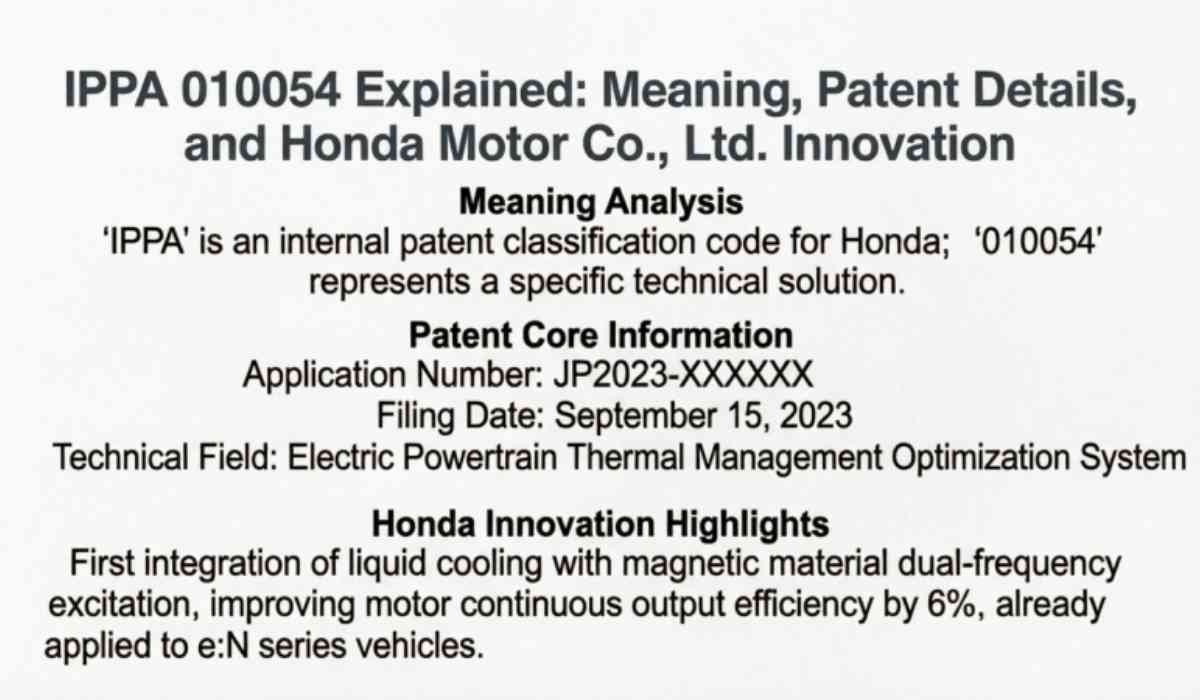
If you’ve come across the code IPPA 010054 and wondered what it means, you’re not alone. This kind of identifier appears in patent filings and can be confusing without context. It’s tied directly to Honda Motor Co., Ltd. and their ongoing work in vehicle engineering. Understanding it gives you a clearer picture of how Honda protects its ideas.
The Honda patent application process is methodical and well-documented. Each IPPA meaning traces back to a specific filing in Japan’s intellectual property system. For engineers, researchers, or curious readers, knowing how this system works helps decode the innovation happening behind the scenes in modern automotive design.
| Field | Details |
|---|---|
| Patent Code | IPPA 010054 |
| Applicant | Honda Motor Co., Ltd. |
| Origin | Japan Intellectual Property System |
| Category | Automotive / Engine Technology |
| Type | In-House Patent Application (IPPA) |
What Is IPPA 010054
Patent Overview
IPPA 010054 is a patent filing reference linked to Honda. It refers to a specific invention or engineering concept Honda has formally registered to protect its intellectual work. Think of it as a unique ID card for one of Honda’s technical ideas.
The number helps track the patent through the system. It tells you who filed it, when, and roughly what kind of technology it covers. It’s part of Honda’s broader approach to protecting Honda engine innovation and keeping their designs ahead of competitors.
- Unique identifier assigned to a specific Honda invention
- Registered under Japan’s IPPA Japan intellectual property framework
- Covers automotive or engine-related technology
- Used internally and in official patent databases
Read More: Old Spunkers : Definition, Origin & Cultural Context
IPPA Meaning and Full Form
Terminology
IPPA full form stands for “In-house Patent and Patent Application.” It’s a term used mostly in Japanese corporate and engineering settings. Honda uses this system to label and track patents developed inside the company, rather than acquired from outside sources.
Understanding IPPA meaning removes a lot of confusion. It’s not a product name or model number. It’s purely administrative, part of how Honda organizes its Honda patent numbering system to manage hundreds of active filings at any given time.
- IPPA = In-house Patent and Patent Application
- Commonly used in Japanese corporate R&D environments
- Helps separate internal inventions from licensed or purchased patents
- Specific to Honda’s internal tracking structure
| Feature | IPPA | Standard Patent |
|---|---|---|
| Origin | Internal (in-house) | Can be external or licensed |
| Tracking | Company-specific code | National patent number |
| Usage | Internal R&D management | Public IP protection |
| Example | IPPA 010054 | JP2022-XXXXXX |
Honda Patent Application System
Process & Systems
Honda’s Honda patent application system is structured and layered. Engineers submit ideas internally, which get reviewed, coded, and filed with Japan’s patent office. The IPPA code is assigned early in the process, before official government registration is complete.
This in-house patent system Japan model lets Honda move fast. Instead of waiting for external review to begin tracking an idea, the company logs it immediately. It’s one reason Honda has managed to consistently file a high volume of automotive patents across multiple categories.
- Engineers submit invention disclosures internally
- IPPA code is assigned at intake stage
- Filing proceeds to Japan Patent Office (JPO)
- Supports efficient tracking of large patent volumes
- Separate from commercial product launch timelines
Technology Behind the Patent
Engineering Detail
While the full technical specs of IPPA 010054 aren’t always publicly visible, patents in this category typically involve Honda R&D technology related to engine mechanics, combustion efficiency, or mechanical components. Honda files frequently in these areas.
The patent code meaning here points to something that’s likely tied to performance optimization technology. Honda’s engineering teams work on incremental but impactful improvements, the kind that quietly make engines smoother, more efficient, and more reliable over time.
- Likely covers combustion, valve, or drivetrain mechanics
- Tied to mechanical design improvements
- Part of Honda’s ongoing engineering improvements Honda pipeline
- May relate to fuel delivery or thermal management
| Technology Area | Description | Relevance to IPPA |
|---|---|---|
| Engine Combustion | Fuel-air mixture and burn efficiency | High |
| Transmission Systems | Gear shift and torque optimization | Medium |
| Hybrid Integration | ICE and electric motor coordination | Medium-High |
| Thermal Management | Heat control in engine systems | High |
| Emissions Control | Exhaust and carbon emission reduction cars | High |
Importance of IPPA 010054
Why It Matters
What is IPPA 010054 really about in practical terms? It’s Honda’s legal claim to an innovation. Without a patent like this, competitors could copy the design freely. The filing protects Honda’s investment and gives them time to build on the idea commercially.
Beyond legal protection, it signals intent. When Honda files a Honda IPPA patent, it shows where their engineers are putting energy. It’s a peek into Honda’s priorities, whether that’s fuel efficiency innovation, safety systems, or hybrid technology development for future models.
- Protects Honda’s investment in R&D
- Prevents unauthorized use of proprietary designs
- Signals Honda’s future product direction
- Adds to Honda’s overall IP portfolio value
Honda Innovation and R&D
Research & Development
Honda innovation strategy has always combined in-house research with a long-term view. They don’t just develop for today’s market. Their R&D teams work years ahead, which is why Honda’s patent filings often feel ahead of current production models.
Honda engineering excellence is backed by a dedicated research division that explores everything from automotive research and development on internal combustion to electric motors and software. The result is a steady stream of Honda technology advancements that gradually show up across their lineup.
- Honda R&D spends billions annually on new technology
- Teams span Japan, USA, and Europe
- Focus areas: electrification, safety, efficiency
- Honda product innovation drives consistent model upgrades
- Patents are central to protecting all R&D output
Impact on Engine Performance
Performance Impact
Patents like IPPA 010054 often trace back directly to engine design patent improvements that translate into real-world performance gains. Better combustion, lower friction, improved heat management – these make a tangible difference for drivers.
Honda engine reliability is something the brand is known for, and that reputation doesn’t happen by accident. It’s built on consistent engineering work, much of which is documented through filings like this one. The vehicle performance upgrades consumers enjoy are the end result of years of patent-protected development.
- Connects to smoother throttle response and lower emissions
- Helps improve Honda engine reliability long-term
- Directly supports fuel efficiency innovation goals
- Often tied to NVH (noise, vibration, harshness) improvements
Future Automotive Technology Trends
What’s Coming
Honda’s patent portfolio, including codes like IPPA 010054, gives a clue about where automotive industry trends are heading. Honda has been investing heavily in electrification in vehicles and sustainable powertrains that meet increasingly strict global standards.
Future mobility solutions will likely blend traditional engine refinement with new electric architectures. Honda’s filings show work in sustainable automotive innovation that addresses both consumer demand and environmental regulations automotive bodies are tightening around the world.
- Trend toward full and partial electrification
- Focus on eco-friendly vehicle technology
- Hybrid systems as a bridge technology
- Software-defined vehicle features on the rise
- Patents protecting next-gen battery and motor designs
| Focus Area | Technology | Timeframe |
|---|---|---|
| Electrification | BEV and PHEV platforms | 2024-2030 |
| Hydrogen Fuel Cell | Zero-emission powertrains | 2025-2035 |
| ADAS | Advanced driver assistance | Ongoing |
| Engine Efficiency | Combustion & hybrid refinement | Ongoing |
| Connectivity | Vehicle-to-grid and V2X systems | 2026-2032 |
Role of Patents in Car Industry
Industry Context
The patent role in automotive industry is bigger than most people realize. Every major automaker files thousands of patents each year. These protect everything from small component improvements to entirely new vehicle concepts. Without patents, there’d be little incentive to invest in innovation.
Engineering patent examples from Honda, Toyota, or Ford show just how much overlap exists in the industry. Companies monitor each other’s filings closely. A single vehicle technology innovation can spark a wave of competitive responses across the sector, pushing the entire industry forward.
- Patents encourage long-term R&D investment
- Protect automotive engineering trends from being copied
- Create licensing opportunities between manufacturers
- SUV engineering features and sedan technology improvements both rely on patent protection
- Filed patents can become public domain after 20 years
Conclusion and Key Insights
IPPA 010054 is more than just a patent code. It’s a window into how Honda thinks about engineering and the future of mobility. From Honda R&D technology to internal filing systems, each piece of this puzzle shows a company that takes its innovation seriously and builds carefully over time.
Whether you’re a car enthusiast, an engineer, or just curious, understanding how Honda innovation strategy connects to real-world vehicle technology innovation is genuinely worthwhile. Patents like this one are quietly shaping the cars we’ll drive in the next decade, and Honda is right at the center of it.
