

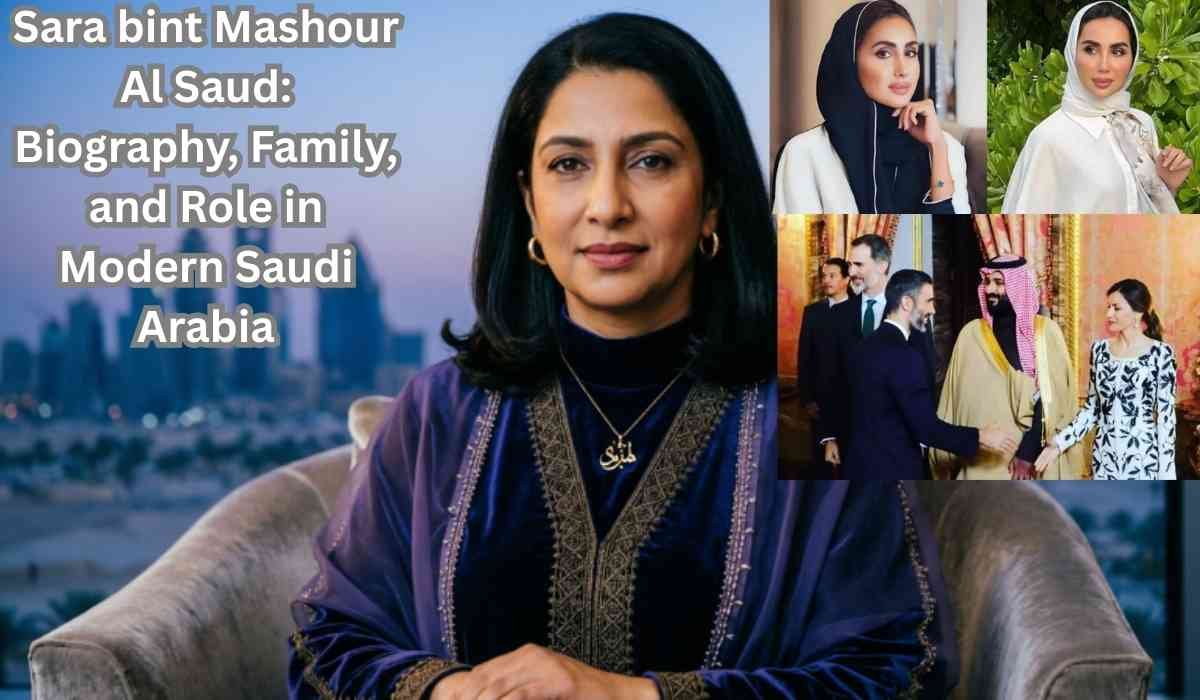
Who Is Sara bint Mashour Al Saud?
Sara bint Mashour Al Saud is one of the most quietly influential figures in the Saudi royal family. She’s the wife of Crown Prince Mohammed bin Salman, making her the Saudi Crown Prince wife and a central figure in the House of Saud today.
Not much is officially documented about her personal life, but her position puts her at the heart of a kingdom going through massive change. As the wife of Mohammed bin Salman, she represents a new generation of Saudi royalty navigating both tradition and transformation.
Sara bint Mashour Al Saud Biography
Sara bint Mashour Al Saud biography begins within the royal walls of the Saudi monarchy. She was born into the Al Saud family, a lineage tracing back directly to the founders of modern Saudi Arabia, which places her among the most prominent women in the region.
Her story is less about public declarations and more about quiet presence. She belongs to a circle where royal responsibilities are understood but rarely publicized, making her a fascinating and somewhat mysterious figure within the influential Middle Eastern monarchy.
| Detail | Information |
|---|---|
| Full Name | Sara bint Mashour Al Saud |
| Nationality | Saudi Arabian |
| Family | House of Saud |
| Role | Crown Princess of Saudi Arabia |
| Husband | Mohammed bin Salman |
Read more: Alix Earle Height and Weight, Age, Body Measurements, Net Worth & Biography
Sara bint Mashour Al Saud Age and Early Life
Her exact birthdate isn’t widely published, but Sara bint Mashour Al Saud age is estimated to place her in her late thirties. She grew up within the protective and tradition-bound environment typical of Saudi royal family households, shaped by cultural heritage Saudi Arabia holds dear.
Her early life reflects the upbringing common to women of the House of Saud, where education, faith, and family values form the core. The conservative norms in Saudi society were very much part of her world growing up.
Key facts about her early life:
- Born into the Al Saud royal bloodline
- Raised within Saudi Arabia’s royal household traditions
- Education aligned with royal family standards
- Grew up alongside other members of the Saudi royal family tree
- Early life largely kept private per royal custom
Marriage to Mohammed bin Salman
The marriage to Mohammed bin Salman took place around 2008, a union that followed the tradition of first cousin marriage Saudi royalty has practiced for generations. It strengthened family ties within the House of Saud and positioned Sara at the highest level of the kingdom.
The royal wedding 2008 was a private affair, consistent with how the Saudi royal family handles personal milestones. Her Sara bint Mashour Al Saud husband is now one of the most powerful leaders in the world, which puts her in a uniquely significant position.
| Marriage Detail | Info |
|---|---|
| Year | Approximately 2008 |
| Husband | Mohammed bin Salman (MBS) |
| Type | Within Al Saud family |
| Style | Private royal ceremony |
About the marriage:
- A union within the extended Saudi royal lineage
- Followed long-standing royal family customs
- Solidified Sara’s role in the inner circle of power
- Kept largely away from media attention
- Represents continuity in Saudi monarchy tradition
Sara bint Mashour Al Saud Children
Sara bint Mashour Al Saud children include several sons and daughters with Crown Prince Mohammed bin Salman. The children of Mohammed bin Salman are being raised as the next generation of Saudi royal children, with futures deeply tied to the kingdom’s direction.
Details on the children remain limited out of respect for their privacy, which is a common practice among princes and princesses of Saudi Arabia. What’s known is that the family is a close unit, grounded in both Sara bint Mashour Al Saud family values and royal duty.
What we know about her children:
- Multiple children with MBS
- Sons and daughters both confirmed
- Raised within Saudi royal household
- Privacy maintained by royal protocol
- Part of the future House of Saud leadership circle
Role in the Saudi Royal Family
Within the Saudi royal family, Sara holds a position of significant quiet influence. She’s not a public-facing political figure, but her closeness to the Crown Prince makes her part of the inner workings of the Saudi monarchy in ways that matter.
Her leadership role in monarchy is defined by support, family, and the cultural expectations that come with being the Crown Princess. The emerging role of royal women in Saudi Arabia is evolving, and Sara sits at an interesting intersection of old expectations and new realities.
| Role Aspect | Description |
|---|---|
| Title | Crown Princess |
| Influence Type | Private and familial |
| Public Role | Limited but respected |
| Position | Inner circle of Saudi leadership |
Her role includes:
- Supporting Crown Prince Mohammed bin Salman
- Upholding royal responsibilities within the family
- Representing cultural heritage Saudi Arabia holds close
- Participating in select public appearances of Saudi royals
- Being a role model for younger royal women
Connection to King Abdulaziz
Sara is a descendant of King Abdulaziz, the founder of modern Saudi Arabia. This lineage isn’t just symbolic. It carries real weight within the House of Saud, where blood connection to the kingdom’s founder defines legitimacy and standing.
Her connection to King Abdulaziz through the Mashour bin Abdulaziz Al Saud line places her firmly within the core of Saudi royal lineage. This makes her marriage to MBS a union of two strong branches of the same founding family.
Her lineage at a glance:
- Directly linked to King Abdulaziz ibn Saud
- Father is Mashour bin Abdulaziz Al Saud
- Mother reported to be Noura bint Mohammed bin Saud Al Kabeer
- Strong position within the Saudi royal family tree
- Lineage reinforces her standing as Crown Princess
Family Background and Royal Lineage
Sara bint Mashour Al Saud family background is deeply rooted in the Al Saud dynasty. Her father, Mashour bin Abdulaziz Al Saud, was a senior prince, which means Sara was never on the periphery of royal life. She grew up at the center of it.
Her Saudi royal lineage connects multiple powerful branches of the royal family. Understanding her background helps explain why this marriage carried such significance within the Saudi monarchy and why it reinforced the Crown Prince’s position at the top.
| Family Member | Relation |
|---|---|
| Mashour bin Abdulaziz Al Saud | Father |
| Noura bint Mohammed bin Saud Al Kabeer | Mother |
| Mohammed bin Salman | Husband |
| King Abdulaziz | Ancestor |
Family background highlights:
- Father held senior royal status
- Strong maternal lineage within Al Saud
- Part of the founding royal dynasty
- Family known for adherence to conservative norms in Saudi society
- Respected across multiple generations of the royal family
Public Appearances and Royal Duties
Public appearances of Saudi royals are selective, and Sara is no exception. She has appeared at certain official events alongside the Crown Prince, though Saudi royal culture doesn’t push female members into constant public visibility.
Her royal responsibilities are real, even if they stay behind closed doors. When she does appear publicly, it tends to align with significant state or family occasions. Her presence is always understated but meaningful within the context of the Saudi royal family.
Her public presence includes:
- Selective appearances at state events
- Family occasions within the royal household
- Travel with the Crown Prince on official trips
- Presence at culturally significant Saudi gatherings
- Representation of the Crown Prince’s family unit
Influence of Vision 2030
Vision 2030 is reshaping Saudi Arabia from the ground up, and the Crown Princess’s position places her close to those changes. The social reforms under MBS include women empowerment in Saudi Arabia, which directly affects how royal women like Sara are perceived.
Whether Sara plays an active behind-the-scenes role in Saudi modernization reforms isn’t publicly confirmed. But her existence as a prominent royal woman during this period of economic diversification Saudi Arabia is part of the broader story of change the kingdom is writing.
Vision 2030 and its relevance to her role:
- Reform era reshaping women’s visibility
- Women rights reforms Saudi Arabia opened new spaces
- Royal women increasingly represent the modern kingdom
- Sara’s generation bridges tradition and new norms
- Changing role of women in Saudi Arabia includes royal figures too
Women’s Role in Modern Saudi Arabia
The changing role of women in Saudi Arabia under Vision 2030 is one of the most talked-about shifts in the region. From driving rights to attending public events, women empowerment in Saudi Arabia has moved faster in the last decade than in the previous fifty years.
Royal women like Sara sit at the top of this shift. The emerging role of royal women means more visibility, more symbolic responsibility, and more connection to Saudi Arabia global scrutiny on human rights and gender equality.
Key changes for women in Saudi Arabia:
- Women now allowed to drive (2018)
- Greater access to work and public spaces
- Human rights discussions Saudi Arabia increasingly include women
- Female attendance at events now normalized
- Royal women are quiet symbols of this progress
Tradition and Modernity in Saudi Society
Tradition and modernity in Saudi Arabia are in constant conversation, and nowhere is that more visible than in the royal family. Sara represents a woman shaped by deep conservative norms in Saudi society who now lives at the center of a rapidly modernizing kingdom.
This tension isn’t unique to her, but her position makes it more visible. Tradition and modernity in Saudi Arabia are both present in how she carries herself publicly. She’s neither a symbol of resistance nor a figurehead of reform. She’s simply part of a society finding its new balance.
This tension plays out through:
- Royal ceremonies honoring cultural heritage Saudi Arabia
- Modern public roles for Saudi women gradually expanding
- MBS-led reforms changing social expectations
- Family life that balances old values with new realities
- Saudi monarchy adapting to a younger, more global audience
Conclusion
Sara bint Mashour Al Saud remains one of the more private yet significant figures in the Saudi royal family. Her life sits at the crossroads of deep tradition and real change, shaped by royal lineage, her role as the wife of Mohammed bin Salman, and the shifting world around her.
As Vision 2030 continues to redefine Saudi Arabia, figures like Sara carry quiet importance. Her story reflects how tradition and modernity in Saudi Arabia are learning to coexist, one generation at a time, within a kingdom that’s watching its own transformation unfold in real time.
